
Georgios Bouchouras, PhD
Senior Lecturer in Biomechanics
Metropolitan College, in collaboration with University of East London
Biomechanics | Gait Analysis | Ontology Engineer | Prompt Engineer | AI | Recurrent Neural Networks
AI + Knowledge Graph (+Ontologies): The New Standard in Rehabilitation
Posted on May 30, 2025
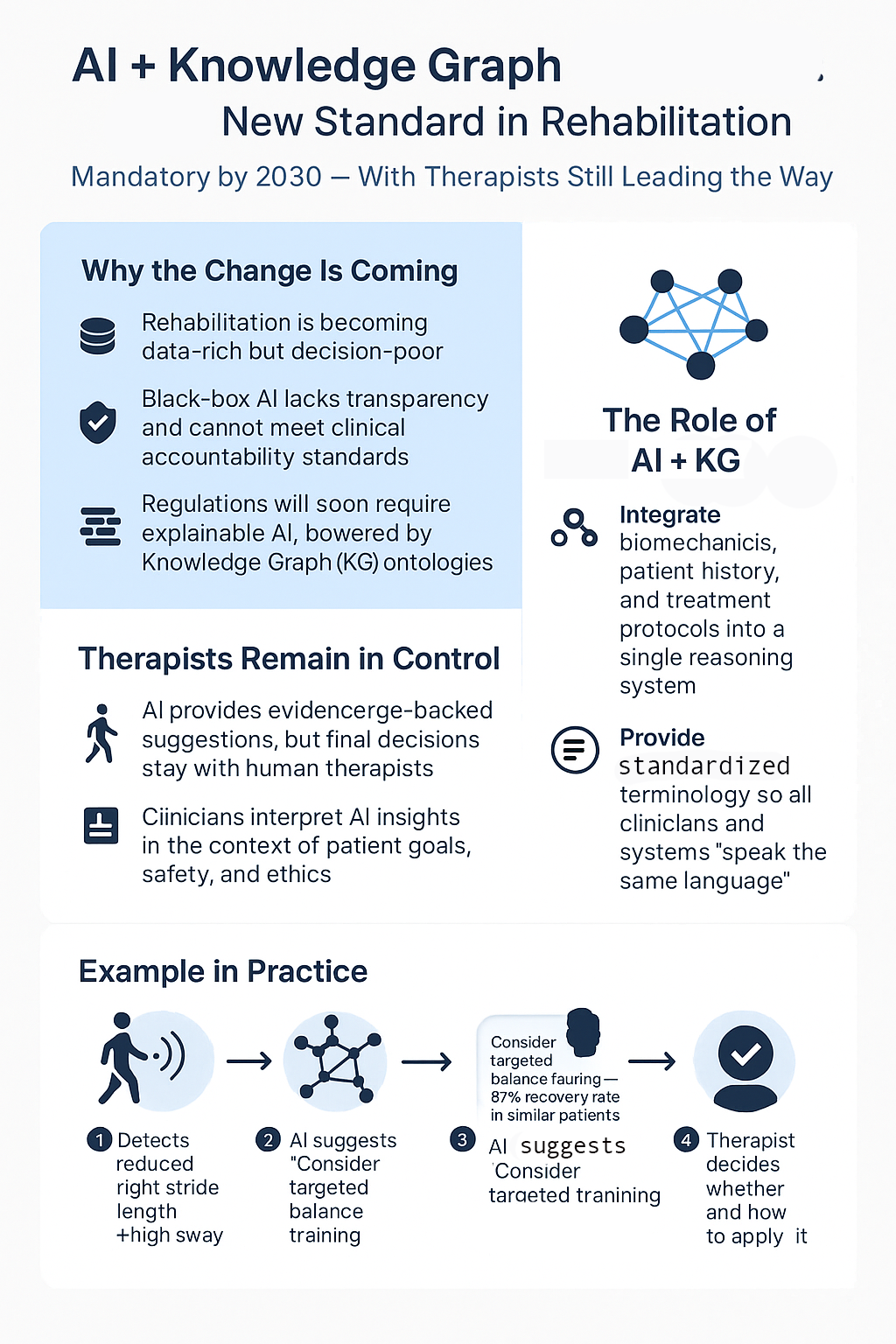
Why the Change Is Coming
- ► Rehabilitation is becoming data-rich but decision-poor
- ► Black-box AI lacks transparency and cannot meet clinical accountability standards
- ► Regulations will soon require explainable AI, powered by Knowledge Graph (KG) + ontologies
The Role of AI + KG Ontologies
Integrate biomechanics, patient history, and treatment protocols into a single reasoning system. Provide standardised terminology so all clinicians and systems “speak the same language”. Trace every recommendation back to its source data and reasoning path
Example: In a modern rehabilitation centre, wearable sensors capture subtle changes in a patient’s gait — reduced right stride length combined with increased lateral sway. A customized framework using AI and KG immediately connects this movement pattern to a database of prior neurological rehabilitation cases, revealing strong similarities to patients recovering from early-stage Parkinson’s disease. Drawing on this evidence, the AI generates an explainable recommendation: “Consider targeted balance training — 87% recovery rate in similar patients.” The therapist, reviewing the suggestion alongside the patient’s medical history, therapy goals, and current progress, makes the final decision on whether and how to apply the intervention. This collaborative process blends machine-driven insight with human clinical judgment. By 2030, rehabilitation centres without such AI + KG (+ontology) systems risk being left behind, as the future of rehabilitation will be transparent, explainable, and firmly therapist-led.
Finally, remember the AI Act regulation
- ► Any AI system intended for medical diagnosis, rehabilitation planning, or treatment decisions is automatically classified as high-risk.
- ► The AI Act requires that high-risk systems: Be transparent and interpretable → Stakeholders must understand the AI’s logic and decision-making process.
- ► Every decision should be linkable to the underlying data and reasoning.