
Georgios Bouchouras, PhD
Senior Lecturer in Biomechanics
Metropolitan College, in collaboration with University of East London
Biomechanics | Gait Analysis | Ontology Engineer | Prompt Engineer | AI | Recurrent Neural Networks
Sports Injury Prediction Is Broken — Here’s How Semantic AI Can Fix It
Posted on April 13, 2025
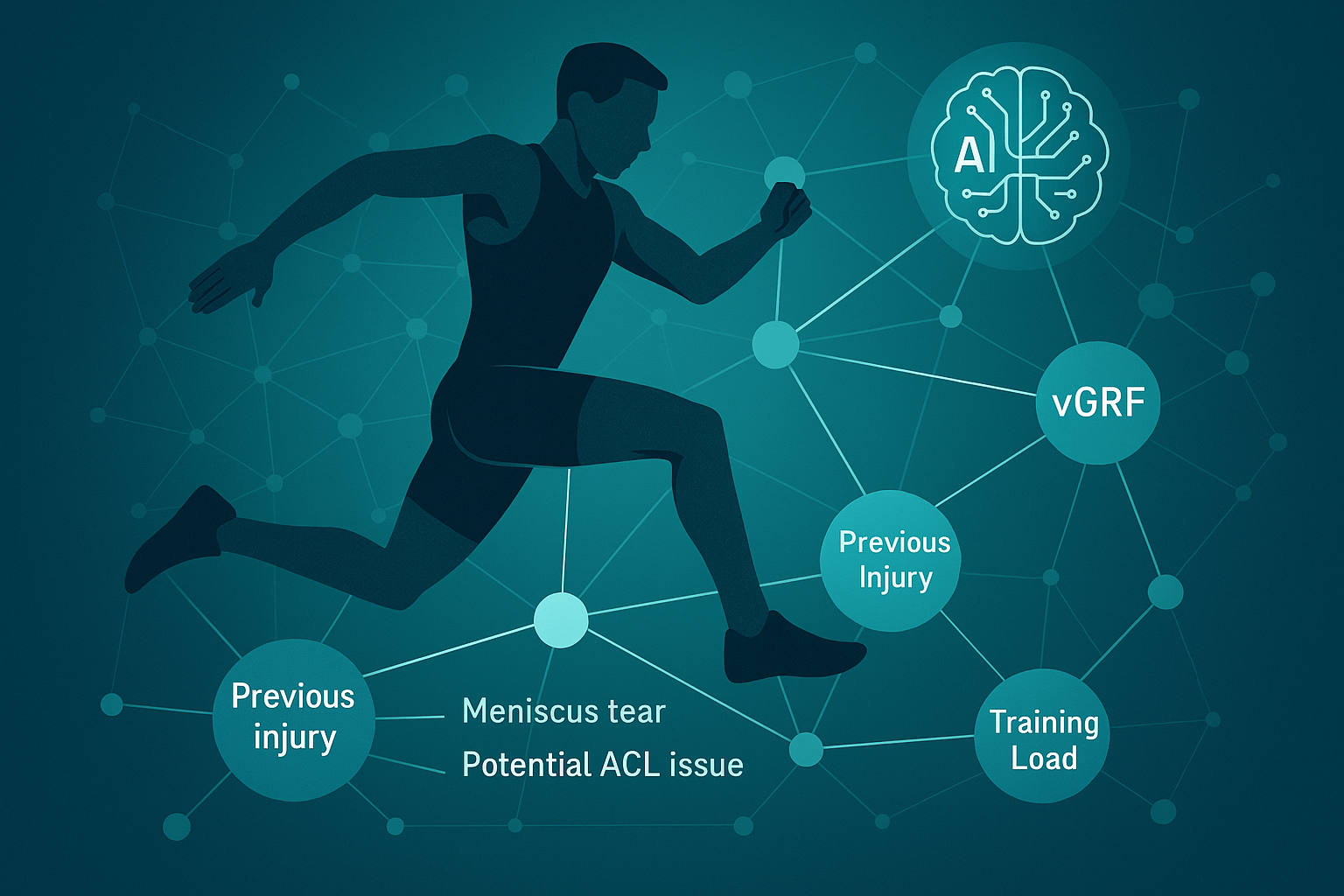
Years ago, during a long jump training session — a sport I loved and trained hard for — I felt something go wrong in my knee as I pushed off. It turned out to be a meniscus tear. My ACL wasn’t torn, but it was likely affected. That moment changed everything. I couldn’t return to training the way I used to, and over time, that experience led me in a new direction — eventually to a PhD focusing on knee mechanics and ACL reconstruction.
Since then, I’ve worked at the intersection of biomechanics, artificial intelligence, and data science. And every now and then, I still wonder:
"Could that injury have been predicted — or even prevented — if we had the right systems in place?"
Today, I believe the answer is yes. But it requires us to start thinking differently about how we use the data we already have.
We Have the Data — But Not the Full Picture
We can now collect almost any kind of movement or performance data: vertical ground reaction forces (vGRF), muscle activation (EMG), joint angles, injury history, training load — you name it. The problem? Most of it lives in separate systems that don’t communicate with each other.
What’s even more surprising is how often teams and coaches collect all this data, but don’t really keep or revisit it. They run tests, gather numbers, maybe share a report — and then move on. A season later, there’s nothing to compare against. No baseline. No history. And that’s odd, considering how easy it’s become to track athletes consistently using wearables, cloud systems, and portable tech.
The issue isn’t about collecting more data. It’s about making sense of it — connecting the dots, seeing patterns, and understanding how all the pieces interact over time.
Connecting the Dots with Semantic AI
This is where knowledge graphs and semantic AI come in.
A knowledge graph lets us organize data by showing how things are related — not just storing numbers, but connecting them. For example:
- The athlete had a meniscus tear.
- Their vGRF data shows asymmetrical loading.
- EMG shows delayed activation in one muscle.
- Training load has been elevated for several weeks.
When those pieces are connected, a system can reason through them and say something like:
“This athlete is showing signs of increased risk. It’s worth taking a closer look.”
This isn't just about prediction for the sake of numbers — it’s about prevention that makes sense.
Why It Matters
Having lived through injury and spent years researching how and why these things happen, I see a real opportunity here. This approach isn’t just useful for elite athletes — it can help coaches, therapists, and anyone who wants to train smart and stay injury-free, for a longer period.
Imagine being able to catch a problem before it becomes serious — not because someone noticed something during warm-up, but because a connected system flagged it based on real data and context.
Final Thoughts
We’ve got the sensors. We’ve got the data. And we definitely have the computing power. What we’ve been missing is the structure — a way to tie it all together and use it in a meaningful way.
Semantic AI can help us do just that. Not just to treat injuries after they happen — but to catch them early, and maybe stop them from happening at all (or at least, try better, fail better 😉).